Choosing what wall finish is best for commercial spaces in China requires more than matching a color palette. A busy café, hotel corridor, clinic, and retail showroom face different pressures. Fingerprints, trolley impacts, humidity, cleaning chemicals, and harsh lighting quickly expose weak specifications. In practice, the most attractive sample is not always the most durable solution.
Industry guidance supports a performance-led approach. China’s GB 18582-2020 standard regulates harmful substances in interior architectural coatings, including volatile organic compounds. Designers should request current test reports, product declarations, and batch information before approval. The World Green Building Trends 2021 report by Dodge Data & Analytics also identified healthier materials and operational efficiency as major priorities for commercial construction. These findings matter in China, where owners increasingly connect material choices with tenant comfort and long-term asset value.
For many projects, low-VOC water-based coatings offer a practical starting point. High-scrub finishes suit retail walls near entrances, while textured coatings can hide minor surface damage. However, texture may collect dust. Glossy surfaces clean easily, yet they reveal uneven plaster and reflected glare. That trade-off is easy to overlook.
The final decision should consider moisture, cleaning frequency, fire requirements, repair access, and local climate. Mock-ups under actual lighting are essential. A finish that performs well in Shanghai may behave differently in a dry northern city. There is no universal winner. The better question is not simply what wall finish is best for commercial spaces, but which finish remains safe, maintainable, and visually credible after years of use.
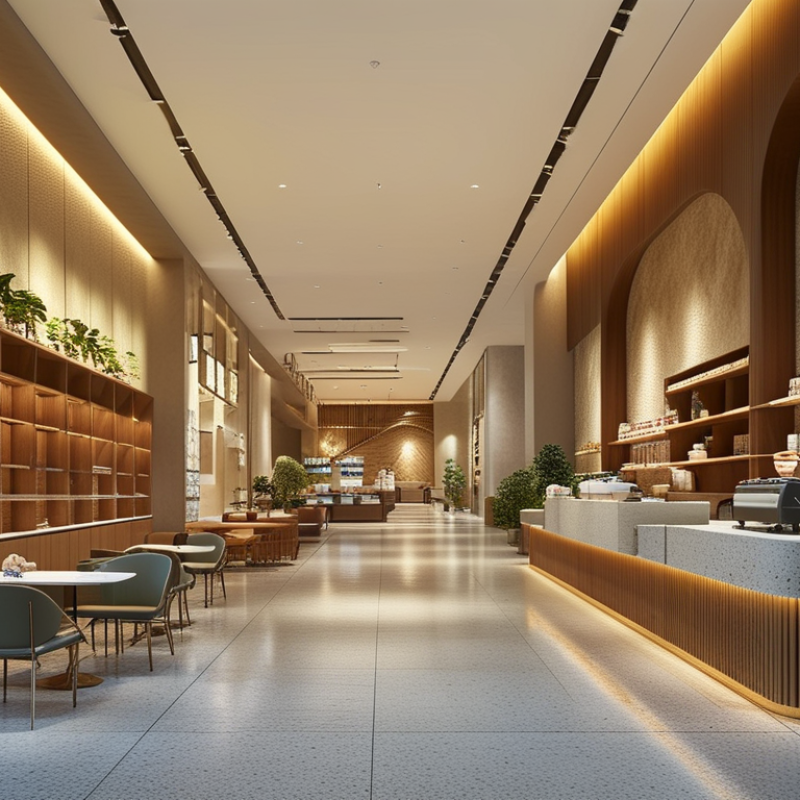
In Chinese commercial interiors, wall finishes must meet more than appearance goals. They should withstand cleaning, impact, humidity, and frequent occupancy. Fire performance is non-negotiable. GB 8624-2012 classifies reaction-to-fire performance, while GB 50222-2017 guides interior decoration fire protection. Project teams should verify the complete wall build-up, not only the surface coating. Adhesives, primers, and backing boards can change the result.
Indoor emissions also require measurable control. GB/T 18883-2022 sets indoor formaldehyde at 0.08 mg/m³ for a one-hour average and TVOC at 0.60 mg/m³ for an eight-hour average. These figures make low-emission primers and finishes practical requirements, especially in offices, clinics, and retail units. The China Building Energy Consumption Annual Report 2023 estimates that building operations represented about 21.7% of China’s total energy use. Reflective, light-colored walls can improve daylight distribution, but they cannot replace shading or efficient equipment.
For busy corridors, a washable, repairable finish usually performs better than a delicate decorative surface. Moisture-resistant systems matter near kitchens and washrooms. Acoustic panels may help, yet porous faces can collect dust. A sample board should face scrubbing, impact, and humidity tests before approval. We sometimes overvalue the first visual impression. That is a design weakness. Record cleaning chemicals, color change, repair time, and local installer skill in the specification. The best finish remains compliant and serviceable after opening day.
Choosing a wall finish in China starts with the building, not the catalogue. Commercial interiors face humidity, dust, heavy traffic, and frequent cleaning. Local fire-safety requirements, indoor-air-quality targets, and maintenance plans should guide every specification. An attractive sample can still fail on a busy corridor. That mistake is costly.
Low-VOC paint suits offices, retail units, and restaurants needing flexible colour changes. It is economical, but corners may show scuffs quickly. Porcelain tile handles moisture and cleaning well, making it practical for washrooms, kitchens, and entrance zones. However, grout lines require regular attention.
Decorative stone offers a strong, premium appearance, yet its weight and installation cost need careful review. Timber veneer adds warmth to reception areas and meeting rooms. It needs stable humidity and protection from impact.
Acoustic wall panels can improve sound control in open offices and hospitality spaces. Their surface must resist dust and meet applicable fire-performance requirements. Textured wallcoverings create visual depth, but damaged sections may be difficult to match later. In practice, I recommend testing full-size samples under real lighting. Check the substrate, joint details, cleaning method, and replacement process. Small mock-ups often reveal glare, uneven colour, or weak edge protection. Specifications should also confirm product documentation and local compliance. I have seen projects overvalue appearance and underestimate maintenance. That balance deserves more honest discussion.
What Wall Finish Is Best for Commercial Spaces in China?
How to Compare Durability, Maintenance, and Cost
Choosing a wall finish for a commercial space in China requires more than comparing shelf prices. Daily traffic, humidity, cleaning routines, and repair access shape the real cost. In busy retail corridors, waterborne coating offers a low initial cost and quick color changes. Yet carts, luggage, and frequent wiping can leave marks within months. A washable, harder coating performs better, but preparation and labor increase the budget.
Ceramic tile and dense wall panels usually resist impacts, moisture, and repeated cleaning. They suit restaurant splash zones, hospital corridors, and building entrances. Their durability is valuable where repairs interrupt business. However, grout can darken, cracked tiles require matching replacements, and panels may show scratches. Installation tolerances matter. A strong material cannot hide poor substrate preparation or uneven joints. Confirm local fire, hygiene, and indoor-air requirements before approval.
Compare finishes over five to ten years, not one invoice. List installation, protective trims, cleaning labor, touch-ups, replacement stock, and disposal. A simple lifecycle table often changes the decision. For a humid southern city, moisture resistance may outweigh cheaper paint. For a dry office with light traffic, repainting may remain sensible. Ask the contractor for a sample panel and test it with the planned cleaner. This small trial reveals sheen changes, stains, and cleaning effort. Estimates can be too optimistic. Site evidence deserves equal attention.
Comparison of durability, maintenance efficiency, and installed cost for common commercial wall finishes.
Higher scores indicate better performance. Scores are normalized from indicative mainland China commercial fit-out benchmarks: installed cost of approximately RMB 45–500/m², expected service life of 3–25 years, and routine maintenance of approximately RMB 3–15/m² per year. Local labor, substrate condition, fire-rating requirements, and project scale can change the final quotation.
What Wall Finish Is Best for Commercial Spaces in China?
China’s climate makes wall-finishing decisions more technical than they appear. The China Climate Change Blue Book 2024 reports warming of approximately 0.31°C per decade from 1961 to 2022. Hotter summers can increase condensation, mildew, and coating movement in humid cities. In northern regions, dry winters and indoor heating may cause cracking. A durable commercial wall therefore needs moisture resistance, cleanability, and controlled vapor movement. It should not merely look smooth.
Fire performance is equally important. GB 50222-2017 governs fire protection for interior decoration, while GB 50016-2014, with later amendments, addresses building fire safety. Wall finishes must match the building’s occupancy, height, escape routes, substrate, and sprinkler provisions. Under GB 8624, materials receive reaction-to-fire classifications, such as A, B1, B2, or B3. The required class can change between a shopping area, hotel corridor, clinic, and office lobby. Check the project drawings.
Do not rely on a decorative sample. Require current test documentation, substrate-specific installation details, and records from accredited laboratories. The 2024 China Building Energy Consumption and Carbon Emissions Report also highlights the continuing importance of operational building performance. Low-odor, low-maintenance finishes can support healthier interiors and reduce repainting disruption. Yet “low VOC” alone does not prove fire compliance. This is where projects often become careless. A practical choice may be a non-combustible mineral-based finish or a tested high-performance coating system, selected after local humidity, cleaning chemicals, and fire-control conditions are reviewed.
| Wall Finish Type | Typical Commercial Applications | Performance in China's Climate | Moisture and Mold Considerations | Cleaning and Maintenance | Fire-Safety Considerations | Key Advantages | Main Limitations | Overall Suitability |
|---|---|---|---|---|---|---|---|---|
| Ceramic or Porcelain Tile | Toilets, kitchens, food-service areas, healthcare spaces, entrance zones, and high-traffic corridors. | Well suited to humid regions, including southern and coastal areas, when the substrate and joints are properly detailed. | Very good resistance to surface moisture. Mold risk is usually concentrated in grout joints, sealants, concealed cavities, or damp substrates. | Very easy to wash and disinfect. Grout lines require periodic inspection and renewal where staining or deterioration occurs. | Generally non-combustible as a ceramic finish, but adhesives, backing boards, membranes, and concealed wall systems must also comply with the approved design. | Durable, water-resistant, hygienic, impact-resistant, and suitable for frequent cleaning. | Higher installation cost; rigid surfaces can crack if the substrate moves; grout maintenance is required. | Excellent for wet and high-use zones |
| Cement-Based Render or Mineral Plaster | Service areas, utility spaces, stairwells, parking-related areas, back-of-house zones, and robust industrial interiors. | Performs reliably across China's hot-humid, temperate, and cold regions when protected from prolonged water penetration and freeze-thaw exposure. | Mineral and cement-based surfaces are not food sources for mold, but persistent dampness can still cause staining, efflorescence, or mold on dust and coatings. | Low routine maintenance; can be repaired locally. Textured finishes may retain dust and be harder to sanitize. | Usually favorable because the mineral base is non-combustible or highly fire resistant; any paint, sealer, insulation, or decorative layer must be assessed as part of the complete assembly. | Robust, economical, vapor-permeable, and compatible with many substrates. | Can appear utilitarian; may crack from movement; surface texture can reduce cleanability. | Very good for robust service areas |
| Waterborne Acrylic or Similar Interior Paint | Offices, retail areas, classrooms, hotels, corridors, and general public interiors. | Suitable for most conditioned interiors. In hot-humid or poorly ventilated spaces, substrate preparation and ventilation are critical. | Standard interior paint has limited resistance to liquid water. Use a moisture-tolerant system only where the substrate is dry and the product is intended for the environment. | Good touch-up capability and broad color choice. Washability varies significantly by formulation and sheen. | Combustibility and smoke performance depend on the coating, primer, substrate, and total wall build-up. Confirm the required classification under the project design and applicable Chinese standards. | Flexible appearance, relatively low cost, quick repair, and easy color changes. | Can scuff, stain, peel, or support mildew when applied over damp or contaminated substrates. | Best general-purpose option when properly specified |
| Inorganic Mineral or Silicate-Based Coating | Public buildings, corridors, schools, offices, transport-related interiors, and projects emphasizing mineral finishes. | Good vapor permeability can be beneficial in humid climates, but it does not replace waterproofing or control of condensation. | Generally less favorable to mold growth than many organic coatings, provided the wall remains structurally dry and adequately ventilated. | Usually durable and low odor after curing; color matching and localized repairs may be more demanding than with conventional paint. | Often offers favorable fire behavior because of its mineral composition, but the verified rating must cover the complete coating and substrate system. | Vapor-permeable, mineral-based, durable, and suitable for projects with strict material-selection requirements. | Limited elasticity; may show substrate movement, application marks, or color variation if installation is inconsistent. | Strong option for fire-conscious and vapor-permeable interiors |
| Glass-Fiber Wall Covering with Approved Coating | Healthcare, education, hospitality, offices, and high-traffic areas requiring a reinforced painted surface. | Performs well in conditioned spaces and can help bridge minor surface imperfections; condensation-prone walls still require thermal and moisture control. | Can be suitable in moderately humid interiors when fully bonded and coated. Open seams, damaged areas, and damp substrates can lead to hidden moisture problems. | Painted surfaces can usually be cleaned and renewed. Texture and joints affect the ease of disinfection. | Fire performance depends on the wall covering, adhesive, coating, and substrate combination. Obtain project-specific test or classification documentation. | Reinforces the surface, reduces minor cracking visibility, and allows repainting. | Installation quality is critical; removal can be labor intensive; some textured patterns collect dust. | Good for durable painted interiors |
| PVC or Polymer Wallcovering | Selected hospitality, healthcare, retail, and corridor applications where impact resistance or patterned decoration is required. | Useful in controlled interiors, but heat, humidity, substrate alkalinity, and poor ventilation can affect adhesion and dimensional stability. | Surface water resistance can be good, but seams, edges, adhesive layers, and concealed condensation remain vulnerable. | Generally wipeable; damaged sections may be difficult to blend, and seams require careful maintenance. | Must be checked carefully for flame spread, smoke production, and contribution to fire. Do not assume that a surface labeled “fire-retardant” satisfies the project requirement. | Decorative variety, cleanable surface, and good resistance to everyday abrasion in selected products. | Polymer content can increase fire and smoke concerns; may trap moisture if installed over damp walls. | Use selectively after fire and moisture review |
| Decorative Wood Veneer or Solid Wood Panel | Feature walls, reception areas, executive interiors, hospitality spaces, and acoustic design elements. | Requires stable indoor temperature and humidity. Seasonal moisture changes in China can cause movement, joint opening, warping, or veneer failure if detailing is inadequate. | Not recommended for persistently wet locations. Provide a dry, ventilated backing and protect edges, joints, and penetrations. | Requires gentle cleaning and periodic inspection. Surface damage and color change may be visible. | Combustible unless treated and incorporated into a tested, approved wall system. Fire-retardant treatment does not eliminate the need for project-specific compliance documentation. | Warm appearance, acoustic potential, and strong architectural character. | Higher fire, moisture, movement, and maintenance risks than mineral finishes. | Feature use only with documented compliance |
| Metal Wall Panel | Retail interiors, transport facilities, commercial lobbies, industrial areas, and impact-prone feature zones. | Stable in many climates, but thermal movement, condensation, corrosion, and galvanic interaction must be considered in coastal or humid locations. | Surface resistance is generally good; concealed moisture can corrode supports or damage adjacent materials if drainage and ventilation are poor. | Usually easy to wipe clean. Scratches, dents, fingerprints, and coating deterioration may be visible. | Metal faces are generally non-combustible, but cores, paints, adhesives, insulation, joints, and subframes determine the fire behavior of the complete system. | Durable, modern appearance, impact resistance, and good cleanability. | Can transmit sound, show dents, create glare, and require careful detailing at joints and penetrations. | Very good when the complete system is documented |
| Acoustic Fabric or Textile Wall Panel | Meeting rooms, auditoriums, offices, hospitality spaces, and interiors requiring sound absorption. | Best for dry, conditioned interiors. High humidity and condensation can cause odor, staining, microbial growth, or loss of adhesive performance. | Generally vulnerable to liquid water and contamination; avoid in wet rooms and areas requiring frequent disinfection unless the system is specifically designed for that use. | Vacuuming and spot cleaning are typical; replacement may be required after severe staining or water damage. | Textile, foam, backing, and adhesive can contribute to flame spread and smoke. A tested system and required classification documentation are essential. | Improves acoustics, adds softness, and can conceal minor wall irregularities. | Higher fire, staining, moisture, and hygiene concerns than hard mineral finishes. | Use only in dry areas with acoustic and fire documentation |
Selecting a wall finish should begin with the room’s daily pressure, not appearance alone. In busy offices, low-VOC, washable paint supports quick maintenance and safer indoor air. The U.S. Environmental Protection Agency reports that indoor pollutant levels can be two to five times higher than outdoors. Ventilation matters, but finish selection matters too. I have seen dark matte walls reveal hand marks near switches within weeks. A softer sheen often performs better in reception areas.
Retail spaces need stronger resistance to scuffs, cleaning chemicals, and frequent display changes. High-performance coatings or compact porcelain panels suit corridors and fitting rooms. The 2024 China Commercial Real Estate Market Report by JLL highlights continued pressure on landlords to improve asset quality and tenant experience. Durable finishes can reduce repeated repair work. Yet overly hard surfaces may make small shops feel cold. That trade-off deserves testing.
Healthcare and hospitality require stricter hygiene and sensory control. Seamless, cleanable wall systems work well near service counters, while acoustic panels can reduce echo in restaurants and shared offices. The World Health Organization links excessive environmental noise with sleep and health risks. Still, acoustic products can collect dust when poorly detailed. Request samples, clean them repeatedly, and inspect joints under strong lighting. A finish that looks perfect on day one may disappoint after six months.
: Start with the building, not the catalogue. Review humidity, traffic, cleaning routines, fire requirements, and indoor-air targets. An attractive sample can still fail in a corridor.
A washable, repairable finish is usually practical. It should resist scuffs, repeated cleaning, and minor impacts. Corner protection matters. Quite a lot.
Yes, low-VOC paints support indoor-air-quality goals and allow flexible colour changes. Check formaldehyde and TVOC performance through reliable documentation. “Low VOC” alone proves very little.
GB/T 18883-2022 sets indoor formaldehyde at 0.08 mg/m³ for a one-hour average. It sets TVOC at 0.60 mg/m³ for an eight-hour average. Primers, adhesives, and backing boards also affect results.
It is essential. Check GB 8624 classifications and the requirements under GB 50222-2017. The complete wall build-up matters, including substrates, adhesives, primers, and surface layers.
Porcelain tile and moisture-resistant systems generally perform well. Tiles clean easily, but grout lines need regular attention. Poor detailing can still allow moisture problems.
They may reduce sound reflection in open offices and hospitality areas. Their faces should resist dust and meet applicable fire-performance requirements. Porous surfaces can become maintenance headaches.
Use a full-size sample board under real lighting. Test scrubbing, impact, humidity, colour change, and repair time. Check joints, edges, substrate, and replacement methods. Small mock-ups reveal uncomfortable truths.
Hot, humid summers can increase condensation, mildew, and coating movement. Dry northern winters may cause cracking. Select finishes with suitable moisture resistance and controlled vapor movement.
They can improve daylight distribution and reduce some lighting demand. They cannot replace shading, efficient equipment, or proper building operation. We sometimes expect too much from wall colour.
Choosing what wall finish is best for commercial spaces in China depends on more than appearance. A suitable finish must withstand frequent contact, cleaning, humidity, temperature changes, and the daily demands of busy environments. Common options include painted surfaces, wall coverings, decorative panels, tile, and textured coatings, each offering different levels of durability, maintenance, design flexibility, and cost. The right comparison should consider both initial installation expenses and long-term repair or replacement needs.
China’s regional climate, building requirements, fire-safety expectations, and indoor environmental conditions should also guide the decision. High-traffic corridors may require impact-resistant and easy-to-clean finishes, while offices may prioritize comfort and a professional visual effect. Retail, hospitality, healthcare, and educational spaces each have distinct performance needs. By balancing aesthetics, lifecycle cost, maintenance workload, moisture resistance, and safety compliance, property owners and designers can select a wall finish that performs reliably and supports the function of each commercial interior.

RefDura Panle