Can Wall Panels Reduce Noise in a Room?

Time:2026-10-12 Author:Aria
0%

Can wall panels reduce noise in a room? Yes, but their effect depends on the type of noise and the panel’s acoustic design. Most fabric-wrapped, perforated wood, and PET felt panels absorb reflected sound. They do not automatically block voices, traffic, or machinery passing through a wall. That distinction matters.

The ISO 354 standard measures how much sound a material absorbs inside a reverberation room. ASTM C423 reports related absorption values, including the Noise Reduction Coefficient, or NRC. Higher absorption generally means less reflected sound from ceilings, floors, and walls. In practical terms, a meeting room may feel calmer when speech no longer bounces sharply between hard surfaces. The difference can be noticeable near a conference table.

The World Health Organization’s Environmental Noise Guidelines for the European Region connect excessive noise exposure with sleep disturbance, annoyance, and other health concerns. However, wall panels mainly improve room acoustics. They are not a complete solution for outdoor noise or weak sound insulation. A useful installation may cover the first reflection points, especially beside speakers and behind a presenter. Thicker panels and air gaps can improve low-frequency absorption, although results vary by construction.

Real rooms are rarely perfect.

Manufacturers often publish laboratory data, but installation quality changes performance. Furniture, glass, doors, and occupied space also affect reverberation. Therefore, the honest answer is conditional: wall panels can reduce echo and improve speech clarity, while mass-loaded barriers, sealed doors, or upgraded partitions may be needed for sound isolation. A measured acoustic assessment remains more reliable than choosing panels by appearance alone.
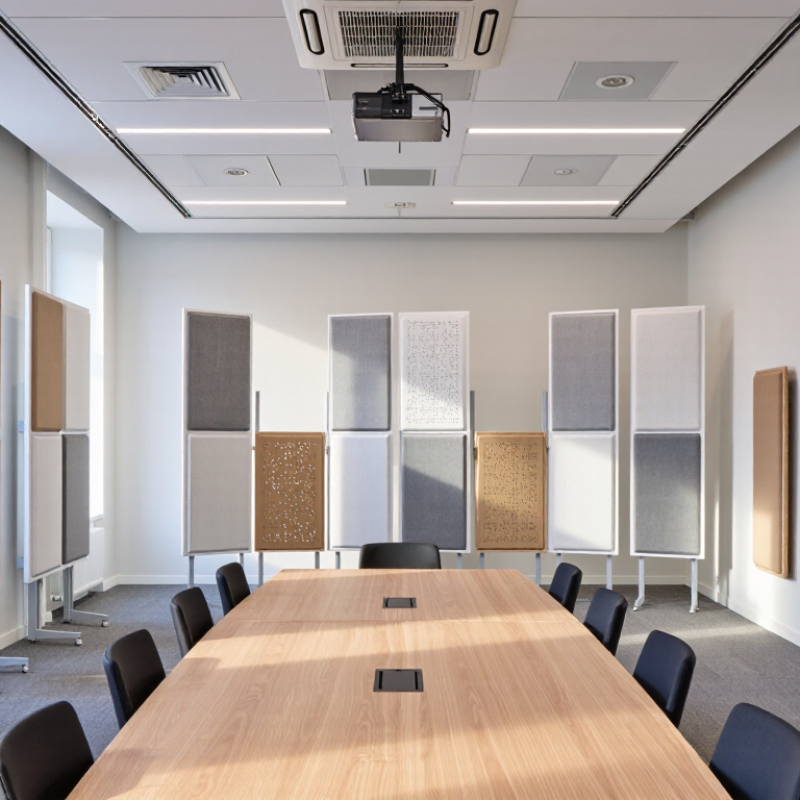
Can Wall Panels Reduce Noise in a Room?

How Wall Panels Affect Sound in a Room

Wall panels change how sound behaves inside a room, mainly by reducing reflections. They do not usually block noise passing through walls. A hard surface can send speech, footsteps, and equipment sounds across the room. Porous panels absorb part of that energy, making voices clearer and lowering the sense of harshness.

Their performance depends on thickness, density, placement, and frequency. The National Research Council of Canada explains that the Noise Reduction Coefficient, or NRC, averages absorption at 250, 500, 1,000, and 2,000 Hz. A panel rated NRC 0.80 indicates strong average absorption across these frequencies, but it does not absorb every sound equally. Low-frequency noise may still remain. That detail is often overlooked.

The ASTM C423 test method measures sound absorption in a reverberation room, using a controlled laboratory setup. Real rooms behave differently. A panel covering a small area may produce limited improvement, while ceiling treatment and corner placement can reduce reflections more effectively. The World Health Organization also links excessive indoor noise with sleep disturbance and reduced concentration, although its guidance does not promise that panels alone will solve these problems. In practice, measurable improvement requires enough coverage and correct installation. Thin decorative panels may look impressive. Their acoustic effect can be modest.

Types of Wall Panels Used for Noise Reduction

Can Wall Panels Reduce Noise in a Room?

Wall panels can reduce noise, but their performance depends on the panel type and room conditions. Acoustic fabric-wrapped panels use porous cores to absorb speech, footsteps, and echoes. They work well in offices, classrooms, studios, and home theaters. PET felt panels offer a lighter option and can add texture to hard, reflective walls. Both types mainly improve sound inside the room. They do not fully block noise from adjacent spaces.

Perforated wood panels combine a decorative surface with an acoustic backing. Their small openings help sound reach the absorptive material behind them. Slatted panels can also reduce reflections, especially when installed over mineral wool or another sound-absorbing layer. For stronger noise control, heavier composite panels may help limit sound transfer through a wall. However, wall panels alone rarely solve low-frequency noise, such as bass or machinery vibration. This is an easy detail to overlook.

Tips: Covering every wall is not always necessary. Start with the wall opposite the main noise source, then assess the room. Leave some hard surfaces for clarity. Place panels near speech areas and reflection points. Seal gaps around doors and penetrations, because sound often travels through weak openings. Panel thickness, spacing, mounting depth, and material density all affect results. A simple test helps: clap near the room center, then listen from each corner. If the echo remains sharp, the treatment may be too limited. Careful placement usually matters more than appearance alone.

Can Wall Panels Reduce Noise in a Room? - Types of Wall Panels Used for Noise Reduction
Wall Panel Type Primary Noise-Control Function Typical Acoustic Performance Common Materials Best-Fit Applications Key Installation Considerations
Fabric-Wrapped Acoustic Panels Absorb reflected sound and reduce reverberation, speech buildup, and echo inside a room. Typical NRC: 0.70–1.00 Porous fiberglass, mineral wool, or polyester fiber core with an acoustically transparent fabric covering. Offices, classrooms, conference rooms, studios, restaurants, and home theaters. Performance depends on core thickness, air gap, panel coverage, and fabric permeability. Seams should be fitted tightly.
PET Felt Acoustic Panels Absorb mid- and high-frequency sound while also providing decorative wall coverage. Typical NRC: 0.30–0.85 Recycled or virgin polyethylene terephthalate fibers formed into rigid felt sheets or molded shapes. Open-plan offices, corridors, meeting rooms, libraries, and educational spaces. Thicker panels and a small air cavity behind the panel generally improve low-frequency absorption.
Perforated Wood Acoustic Panels Combine sound absorption with a wood finish; perforations allow sound energy to reach an absorptive backing. Typical NRC: 0.45–0.85 Perforated or slotted wood veneer, MDF, plywood, mineral wool, or acoustic fleece backing. Auditoriums, music rooms, lecture halls, hospitality interiors, and high-end offices. Open area, perforation or slot pattern, backing material, and cavity depth strongly affect performance.
Wood Slat Acoustic Panels Reduce reverberation through slats separated by gaps and backed by an absorptive layer. Typical NRC: 0.45–0.85 Wood veneer or solid-wood slats mounted over acoustic felt and/or mineral wool. Living rooms, restaurants, offices, recording spaces, and design-focused commercial interiors. Acoustic results vary with slat width, spacing, backing, panel thickness, and whether the wall behind is reflective.
Fiberglass or Mineral-Wool Panels Provide high sound absorption across a broad frequency range, including useful low- and mid-frequency control. Typical NRC: 0.80–1.10 Rigid fiberglass board or mineral wool with a fabric, perforated, or impact-resistant finish. Recording studios, broadcast rooms, industrial spaces, classrooms, and rooms requiring strong reverberation control. Use an appropriate protective finish in areas exposed to impact, moisture, dust, or frequent cleaning.
Polyester Fiber Baffles or 3D Panels Increase absorptive surface area and control sound reflections without requiring a completely flat wall treatment. Typical NRC: 0.45–0.90 Thermoformed or layered polyester fiber, often made partly from recycled PET content. Large offices, cafeterias, multipurpose rooms, schools, and flexible workspaces. Three-dimensional forms and air space can improve absorption, but the tested rating must be checked for the specific configuration.
Acoustic Foam Panels Absorb mainly mid- and high-frequency reflections and help reduce flutter echo in smaller rooms. Typical NRC: 0.30–0.80 Open-cell polyurethane or melamine foam with an exposed, sculpted, or protective surface. Voice rooms, podcast spaces, practice rooms, control rooms, and small studios. Thin foam is less effective at low frequencies. Fire rating, durability, and cleanability should be verified before public or commercial use.
Microperforated Panels Absorb sound through very small perforations and an enclosed air cavity, often without fibrous infill. Typical NRC: 0.40–0.85 Perforated wood, metal, acrylic, or polymer face with a sealed cavity or absorptive backing. Cleanable interiors, laboratories, healthcare areas, transit spaces, and architectural feature walls. Hole diameter, perforation ratio, cavity depth, and panel sealing determine the usable frequency range.
Mass-Loaded or Composite Barrier Panels Reduce airborne sound transmission through a partition by adding mass and, in some systems, damping. STC improvement: system-dependent Flexible loaded-vinyl membranes, gypsum-based boards, resilient layers, and composite construction materials. Partitions between offices, media rooms, bedrooms, mechanical rooms, and noisy adjacent spaces. These are not the same as sound-absorbing panels. Seams, outlets, doors, flanking paths, and wall framing can limit the final result.
Important: Absorption panels primarily make a room quieter and less reverberant; they do not normally provide major sound isolation between rooms. NRC describes sound absorption, while STC describes airborne sound transmission loss of a wall or partition assembly. Actual performance varies with product construction, mounting method, frequency, coverage area, and room geometry.

How Wall Panels Absorb, Block, and Diffuse Sound

Can wall panels reduce noise in a room? Yes, but their effect depends on the noise path and panel design. Porous panels absorb sound energy instead of letting it bounce between hard surfaces. In a furnished room, this can soften speech, reduce flutter echoes, and make conversations easier to follow. The change is often clearest near the wall opposite a speaker. Not everywhere.

Absorption is not the same as blocking. A thin panel will not stop voices, traffic, or music passing through a wall. Blocking needs mass, airtight joints, and often separated wall layers. Gaps around doors, sockets, and ceilings can defeat an otherwise strong assembly. This is where expectations often fail. A panel may make a room quieter inside while doing little for the next room.

Diffusion handles sound differently. Its uneven surface scatters reflections across several directions, preventing a sharp slap from returning to one listening position. Used with absorption, it can preserve some liveliness without creating harsh echoes. Placement matters. Cover early-reflection points near listeners, then test the room by clapping and recording speech. Measurements are better, though a single test remains imperfect. Panel thickness, air gaps, wall materials, furniture, and room size all affect performance. More panels are not always better; an over-treated room can sound strangely dull and disconnected.

Can Wall Panels Reduce Noise in a Room?

Wall panels primarily reduce reflected sound through absorption. Heavier, airtight wall assemblies are needed to block sound, while uneven or slatted surfaces help diffuse reflections.

The sound absorption coefficient ranges from 0 to 1, where higher values indicate that more incident sound energy is absorbed instead of reflected. The values shown are representative of commonly reported laboratory results for these construction types; actual performance varies with thickness, mounting method, air gaps, and room conditions.

Factors That Influence Wall Panel Performance

Can Wall Panels Reduce Noise in a Room?

Factors That Influence Wall Panel Performance

Wall panels can reduce noise, but their effect depends on the problem being treated. Soft acoustic panels absorb reflected sound inside a room. Dense, layered panels may help block sound passing through a wall. These functions are different. Confusing them causes disappointing results.

During a meeting-room project, I noticed harsh echoes near a bare glass wall. We installed panels at ear level and behind the speaker’s position. Voices became clearer, and the room felt calmer within minutes. However, conversations from the next room remained audible. The panels absorbed reflections, but they did not provide enough mass for serious sound isolation. I initially expected too much from a surface treatment.

Panel thickness, density, coverage, and spacing all influence performance. A thin panel covering only a small area may produce limited improvement. An air gap behind the panel can increase low-frequency absorption. Placement matters too. Corners, ceiling surfaces, and large reflective walls often deserve attention. Furniture, carpets, and curtains also change the acoustic balance.

Installation quality is easy to underestimate. Open seams, poor mounting, or an unsuitable backing can reduce effectiveness. Measurements should consider reverberation time, speech clarity, and background noise, not just product ratings. Standardized laboratory data helps, but real rooms behave differently. A contractor should inspect the wall structure, room size, and noise path before recommending materials. Sometimes, the best solution is less visual and more structural.

How to Choose and Install Wall Panels for Better Acoustics

Wall panels can reduce reflected sound, but they rarely make a room completely quiet. The right choice depends on the problem. Echo, speech spill, and outside traffic need different solutions. For sharp voices and clattering dishes, choose porous panels with tested absorption data. Check thickness, density, coverage, and published acoustic ratings. Thicker panels usually absorb lower frequencies more effectively. However, ratings come from controlled rooms, not your furnished office. That difference matters.

Before buying, clap near the room’s center and listen for a ringing tail. Place panels at strong reflection points, such as beside desks, opposite speakers, and on the ceiling when possible. Leave a small air gap behind each panel to improve absorption, especially at lower frequencies. Use fixings suited to the wall surface, and confirm that installation will not damage wiring or plumbing. In practical installations, uneven spacing can look distracting and perform inconsistently. I have also seen rooms with too many panels feel unnaturally dull. Acoustic balance is easy to underestimate.

Tips: Treat the room gradually. Install a few panels, then test speech clarity and echo again. Keep windows and doors in mind. Soft furnishings, bookshelves, and curtains can support the result. Do not cover every hard surface automatically. If low-frequency noise remains, wall panels alone may disappoint; bass control requires larger, carefully positioned treatment. When measurements are unclear, ask an acoustics professional to review the room before purchasing.

FAQS

How do wall panels change sound inside a room?

They absorb some reflected sound from speech, footsteps, and equipment. Voices may sound clearer, with less harshness. Not everywhere.

Can wall panels block noise coming through a wall?

Usually, no. Thin panels reduce reflections inside one room but rarely stop voices or traffic entering from outside. Blocking needs mass, airtight joints, and stronger wall construction.

What does an NRC rating indicate?

It shows average absorption across several middle sound frequencies. A high rating suggests useful absorption, but it does not cover every frequency equally. Low sounds may remain.

Why might thin decorative panels produce little improvement?

Their limited thickness and coverage may absorb only a small amount of sound. They can look impressive while changing the room very little. Appearance misleads.

Where should wall panels be installed?

Place them near early-reflection points, especially opposite speakers and beside listeners. Bare glass walls, ceilings, and corners may need attention. Test before covering everything.

Can air gaps improve panel performance?

Yes, spacing a panel away from the wall can improve absorption at some lower frequencies. The result depends on thickness, density, and the gap size. It is not automatic.

Do panels make conversations easier to understand?

They can reduce flutter echoes and soften repeated reflections. This may help people follow speech during meetings. Background noise may still interfere.

How can someone test a room after installation?

Clap near different walls and record a short conversation. Listen for echoes, dullness, and changes in speech clarity. One test is imperfect, though.

Can too many panels harm the room’s sound?

Yes. Heavy absorption can make a room sound dull, disconnected, or strangely lifeless. More treatment is not always better.

What should be checked before choosing panels?

Inspect the room size, wall structure, furniture, noise path, and existing soft materials. Consider reverberation, speech clarity, and background noise. I once expected surface treatment to solve isolation, but it could not.

Conclusion

Can wall panels reduce noise in a room? Yes, they can improve acoustic comfort by controlling how sound travels and behaves indoors. Rather than simply making a room silent, wall panels can absorb echoes, soften harsh reflections, block a limited amount of sound transfer, or diffuse sound more evenly. Common options include fabric-covered acoustic panels, wood slat panels with sound-absorbing backing, foam panels, and dense barrier-style panels. Each type serves a different purpose, so the best choice depends on whether the main problem is echo, speech clarity, music quality, or noise passing through walls.

Panel performance is influenced by thickness, density, surface design, installation position, room size, and the frequencies that need treatment. For better results, panels should be placed at major reflection points, such as beside seating areas or opposite sound sources, while corners may benefit from additional bass treatment. A thoughtful combination of absorption and diffusion, installed with suitable spacing and coverage, can create a quieter, clearer, and more balanced room.

Aria

Aria

Aria is a dedicated marketing professional with a deep passion for innovative strategies and a keen understanding of our company's product offerings. With a wealth of experience in the industry, Aria excels at crafting engaging content that highlights the unique features and benefits of our......